Monday, June 11, 2012

Thursday, May 31, 2012
Inquiry with artefacts
When we begin with a new unit of inquiry, the first thing we want to do is assess the prior knowledge of the students and then 'tune' them into the unit.
When I began my teaching career, like many other teachers 'tuning in' was to merely build students' interest into the unit. I would show them movies, take them on field trips, call a guest speaker and then just move on to 'finding out' information, which is the next stage of inquiry. However, over the years, I have come to realise that this 'tuning in' stage is in fact one of the most important stages of any inquiry cycle. I say so because it is after this stage that the students frame their inquiry questions which in turn drive the entire unit!
Off late, in the PYP workshops I've attended, the workshop leaders have emphasized highly on the use of artefacts in teaching and learning. Artefacts are nothing but objects that signify something. For example, antiques and maps can be the artefacts that symbolise ancient civilizations. For light and sound, the artefacts can be torch lights, bulbs, speakers, glass, spectacles, prisms, musical instruments and the list can go on.
For young learners, things that they can see, hold, touch, hear, feel and sometimes smell, take their imaginative thinking to a completely different level. The most abstract concepts become concrete. Artefacts open doors to new ideas and perspectives. They help them build their understanding of the world around them. For a bunch of six year olds, the concept of relationships is so hard to understand. But, if you give in their hands, pictures of families, tokens of friendship and gifts from loved ones, you will be taken by surprise! A tea strainer can help ten year olds understand filtration inside our bodies!
If you really think about it, anything around us can be used as an artefact for conceptual understanding or creativity. The glass in which we drink water can used for units on materials, water, light and quantity and measurements (in math). You may use it in language to come up with a descriptive essay or to just make up a story! You may also touch upon the essential elements of PYP with these simple objects.
Having made these observations, I ensure the increased usage of these in the different subject disciplines. It is also a great idea to have a display of them in the classroom. My current unit of inquiry is on traditions and rituals and the central idea is: Traditions, rituals and artefacts help us understand the beliefs and values of different cultures. I thought it was important for the student learn 'about' artefacts along with learning 'through' artefacts.
For tuning in, we did a bus stop activity. many artefacts were laid out on the tables and groups of students analysed each artefact in turns. They were asked to write what they see, what they think it is and what they wonder (Visible thinking tool, Harvard Project Zero).


We spent two days looking at these interesting objects. On the third day, the groups were asked to come up with inquiry questions. By then they knew to differentiate between conceptual and factual questions (we call them fat and skinny questions). They took the help of the key concepts come up with the questions and I must say, they were much better than I had anticipated! I also grouped them according to the lines of inquiry.

On the next day, the students also came up with the central idea. For the finding out stage, we watched the movie 'Around the world in 80 days' and constructed the meaning of culture using http://museumbox.e2bn.org/. We have also set up a wiki http://cultureexchangeproject.wikispaces.com/ to exchange information about different cultures. Do visit is and add in info if you feel like.
When I began my teaching career, like many other teachers 'tuning in' was to merely build students' interest into the unit. I would show them movies, take them on field trips, call a guest speaker and then just move on to 'finding out' information, which is the next stage of inquiry. However, over the years, I have come to realise that this 'tuning in' stage is in fact one of the most important stages of any inquiry cycle. I say so because it is after this stage that the students frame their inquiry questions which in turn drive the entire unit!
Off late, in the PYP workshops I've attended, the workshop leaders have emphasized highly on the use of artefacts in teaching and learning. Artefacts are nothing but objects that signify something. For example, antiques and maps can be the artefacts that symbolise ancient civilizations. For light and sound, the artefacts can be torch lights, bulbs, speakers, glass, spectacles, prisms, musical instruments and the list can go on.
For young learners, things that they can see, hold, touch, hear, feel and sometimes smell, take their imaginative thinking to a completely different level. The most abstract concepts become concrete. Artefacts open doors to new ideas and perspectives. They help them build their understanding of the world around them. For a bunch of six year olds, the concept of relationships is so hard to understand. But, if you give in their hands, pictures of families, tokens of friendship and gifts from loved ones, you will be taken by surprise! A tea strainer can help ten year olds understand filtration inside our bodies!
If you really think about it, anything around us can be used as an artefact for conceptual understanding or creativity. The glass in which we drink water can used for units on materials, water, light and quantity and measurements (in math). You may use it in language to come up with a descriptive essay or to just make up a story! You may also touch upon the essential elements of PYP with these simple objects.
Having made these observations, I ensure the increased usage of these in the different subject disciplines. It is also a great idea to have a display of them in the classroom. My current unit of inquiry is on traditions and rituals and the central idea is: Traditions, rituals and artefacts help us understand the beliefs and values of different cultures. I thought it was important for the student learn 'about' artefacts along with learning 'through' artefacts.
For tuning in, we did a bus stop activity. many artefacts were laid out on the tables and groups of students analysed each artefact in turns. They were asked to write what they see, what they think it is and what they wonder (Visible thinking tool, Harvard Project Zero).


We spent two days looking at these interesting objects. On the third day, the groups were asked to come up with inquiry questions. By then they knew to differentiate between conceptual and factual questions (we call them fat and skinny questions). They took the help of the key concepts come up with the questions and I must say, they were much better than I had anticipated! I also grouped them according to the lines of inquiry.

On the next day, the students also came up with the central idea. For the finding out stage, we watched the movie 'Around the world in 80 days' and constructed the meaning of culture using http://museumbox.e2bn.org/. We have also set up a wiki http://cultureexchangeproject.wikispaces.com/ to exchange information about different cultures. Do visit is and add in info if you feel like.
Sunday, May 20, 2012
NEw Project: The Health Journal
We will start working on our next project "The Health Journal" from tomorrow. We will using www.wikispaces.com for this. The link to the wiki page is: http://thehealthjournal.wikispaces.com/
Visit this link and join the wiki by clicking on 'join' (right hand top corner of the page). You can add information on the wiki only if you are member.
Visit this link and join the wiki by clicking on 'join' (right hand top corner of the page). You can add information on the wiki only if you are member.
Friday, May 18, 2012
Creative + Critical thinking
This week was filled with a lot of group work. The students worked collaboratively to create colourful posters and shapes.
To better understand the interdepence of body systems, the students were divided into four groups and each group was asked to conduct research about two different body systems. The students then created posters to show the interdepence and also presented them to the class. This is what they look like:
 Tushita, Aliza and Ayaan
 Zia, Aman and Nabil
 Isha, Aahil, Alisha and Anik
 Armaan, Muskan and Riya
Followed by this, the students made connections between all the body systems using a sheet of paper and satin ribbons.


In Math, we were learning how to construct different shapes using geometic tools. Along with the drawing skills, students are also learning a lot of geometric vocabulary: types of angles, types of triangles, etc. Concepts like scaling, decimals and measurements are bein reiterated.
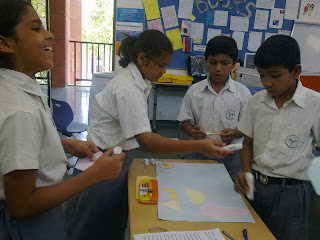
We worked on a project for applying the meaning of 2D shape and measurements. Students were divided into group based on mixed abilities and they were a list of different shapes to construct: circles with given radius/diameter, triangles (different types), square, rectangle, pentagon, hexagon and octaon. They were asked to construct these shapes on coloured paper and cut them. The students then created different things with these shapes.



To better understand the interdepence of body systems, the students were divided into four groups and each group was asked to conduct research about two different body systems. The students then created posters to show the interdepence and also presented them to the class. This is what they look like:


Followed by this, the students made connections between all the body systems using a sheet of paper and satin ribbons.


In Math, we were learning how to construct different shapes using geometic tools. Along with the drawing skills, students are also learning a lot of geometric vocabulary: types of angles, types of triangles, etc. Concepts like scaling, decimals and measurements are bein reiterated.
We worked on a project for applying the meaning of 2D shape and measurements. Students were divided into group based on mixed abilities and they were a list of different shapes to construct: circles with given radius/diameter, triangles (different types), square, rectangle, pentagon, hexagon and octaon. They were asked to construct these shapes on coloured paper and cut them. The students then created different things with these shapes.


I am really very proud of the efforts put in by all the students. What a wonderfully satisfying week!
Thursday, May 17, 2012
Interactive:
http://www.bam.gov/index.html
http://yucky.discovery.com/flash/body/
http://www.nourishinteractive.com/kids/healthy-games/6-kevins-build-a-meal-game-balanced-meals
http://www.foodchamps.org/
http://cspinet.org/smartmouth/
Lots of information:
http://kidshealth.org/kid/stay_healthy/index.html
http://www.brainpop.com/health/diseasesinjuriesandconditions/
http://www.bam.gov/index.html
http://yucky.discovery.com/flash/body/
http://www.nourishinteractive.com/kids/healthy-games/6-kevins-build-a-meal-game-balanced-meals
http://www.foodchamps.org/
http://cspinet.org/smartmouth/
Lots of information:
http://kidshealth.org/kid/stay_healthy/index.html
http://www.brainpop.com/health/diseasesinjuriesandconditions/
Tuesday, May 8, 2012
Ayaan's blog: Reflection on yesterday's activity on skeletal sys...
Ayaan's blog: Reflection on yesterday's activity on skeletal sys...: Skeletal system Yesterday, we did an activity which helped us to understand about how bones help us and forms...
No bones about it!!

The groups are trying to make a 'standing' model of the human body with play dough.


These couldn't realy stand!!


They were then given icecream sticks. The students started using them in different ways.


Finally, the students were given different cereals that represented different organs (white chick peas for brain, black chick peas for heart, small kidney beans for kidneys, etc.). These were to be inserted in the right places inside the figurine.


What we learnt was that our bones give us structure. They help to stand up straight - without them we would be floating like jelly! The joints help in moving our bones.
The bones also protest some internal organs.
Targets for writing
Tushita
- Use
of new and interesting words (including adjectives and adverbs)
- Can
use or attempt grammatically complex structures, (e.g. expansion before
and after the noun – ‘The little, old man who lived on the hill…;
subordinating clauses – ‘I felt better when..; ‘who taught me the
guitar.’)
- Use
of famous quotes
Isha
- Apostrophe
(Example: Archana’s) + Contractions
- Use
of new and interesting words (including adjectives and adverbs)
- Varying
sentence structure
Muskan
- Spelling
- Punctuation:
commas, Question mark
- Use
of conjunctions in the right places
Aliza
- Spelling
- Legibility
(Handwriting)
- Maintain
the interest level of the reader
Armaan
- Apostrophe
(Example: Archana’s) + Contractions
- Spelling
- Capitalization
- Maintain
the interest level of the reader
Anik
- Tense
of verbs
- Punctuation:
commas, Question mark
- Use
of conjunctions in the right places
Aman
- Spelling
- Legibility
(Handwriting)
- Appropriateness
to audience (Example: A letter to a friend must not sound like an essay)
Alisha
- Maintain
the interest level of the reader
- Use
of new and interesting words (including adjectives and adverbs)
- Use
of figures of speech (simile, metaphor, personification, alliteration)
Zia
- Use
of new and interesting words (including adjectives and adverbs)
- Can
use or attempt grammatically complex structures, (e.g. expansion before
and after the noun – ‘The little, old man who lived on the hill…;
subordinating clauses – ‘I felt better when..; ‘who taught me the
guitar.’)
- Use
of famous quotes
Ayaan
- Use
of new and interesting words (including adjectives and adverbs)
- Varying
sentence structure
- Use
of figures of speech (simile, metaphor, personification, alliteration)
Riya
- Use
of new and interesting words (including adjectives and adverbs)
- Use
of direct and indirect speech
- Varying
sentence structure
Nabil
- Use
of new and interesting words (including adjectives and adverbs)
- Varying
sentence structure
- Apostrophe
(Example: Archana’s)
Monday, May 7, 2012
Sunday, May 6, 2012
Friday, May 4, 2012
Thursday, May 3, 2012
Tushita's blog: When Santa fell to Earth - Corneilus Funke
Tushita's blog: When Santa fell to Earth - Corneilus Funke: Everybody thinks a Santa is a stout, old, chubby man with a long snow white beard and a stomach that sticks out, but no. Have you ever ...
Wednesday, May 2, 2012
Symmetry, Reflection and Translation
These are the websites we used to learn Symmetry, reflection and translation on the Interactive White board. You may try them at home if you want to:
Reflection:
http://nlvm.usu.edu/en/nav/frames_asid_297_g_2_t_3.html?open=activities
http://www.mathsisfun.com/geometry/reflection.html
Translation:
http://www.teacherled.com/resources/translation/translationload.html
http://www.shodor.org/interactivate/activities/GeneralCoordinates/
http://www.mathsisfun.com/geometry/translation.html (Also try the questions given at the bottom)
Try these symmetry games:
http://www.hbschool.com/activity/elab2004/gr3/21.html
http://www.innovationslearning.co.uk/subjects/maths/activities/year3/symmetry/shape_game.asp
Reflection:
http://nlvm.usu.edu/en/nav/frames_asid_297_g_2_t_3.html?open=activities
http://www.mathsisfun.com/geometry/reflection.html
Translation:
http://www.teacherled.com/resources/translation/translationload.html
http://www.shodor.org/interactivate/activities/GeneralCoordinates/
http://www.mathsisfun.com/geometry/translation.html (Also try the questions given at the bottom)
Try these symmetry games:
http://www.hbschool.com/activity/elab2004/gr3/21.html
http://www.innovationslearning.co.uk/subjects/maths/activities/year3/symmetry/shape_game.asp
Subscribe to:
Posts (Atom)